expressed already by professor Hubert Grimme,
an
expert of proto-Sinaitic inscriptions, in
his
article on the “Alphabet” in the
Encyclopaedia
Judaica of 1928, but he was unable to prove it.6)
§
4. Why Alef and Bet were placed at
the
top of the alphabetical order is a question
about
which I had always been wondering.7) The text
of the
Ten Commandments begins with
the
Hebrew word ANKI (English
“I”), and thus
with the letter
Alef, as can be seen at the first
glance.8) If it was, indeed, the first
letter of the
末末末末末末末
of their state as the Romans, later on,
counted the years after
the foundation of
their city. Thus King Solomon began to
build
the First Temple in
the 4th year of his reign (961
B. C. E.)
and in the 480th year
after the Exodus (1. Kings 6, 1),
which
was in 1441 B. C.
E. The accuracy of historical
chronology
does not stand upon astronomical niceties, but on the
continuity
of counting the recurring seasons of
the year or the number of
springs in the life of a republic rather than an individual,
regardless
of whether spring is early or late in a particular year.
6) Cf. Hubert Grimme, op. cit. supra
at 405; and similarly
Kurt Galling in his article “Dekalog” in the
Encyclopaedia Judaica
of 1930 at
899. Since the proto-Sinaitic
inscription on the
pedestal of
a small sphinx found by
Sir Flinders Petrie is
generally
dated around 1500 B. C. E., it
is very close in time
and place to
the two stone tablets of the Torah of Moses
from
the Sinai, and would be only a few decades earlier.
7) See TORAH OF
THE ALPHABET (N. 1)
p. 21.
8) This fact could be neglected, if both the
sarcophagus
of King Achiram of Byblos
and the Exodus were to be dated
[7]
first text in alphabetical
script,
this would be
a good reason for
placing it at the top of the
alphabetical order,
because everybody who wanted
to learn how to read and write the newly
invented
alphabet had to begin with this
very Alef in the
absence of any
other alphabetical literature.9)
In this case a
similar reason should be expected
for placing Bet next after
Alef.
§
5. Investigating why the letter Bet holds the
second place in
the alphabetical order I searched
for the first Bet in the text
of the Ten Command-
末末末末末末末
in the thirteenth century B.
C. E. But the real
age of the
Achiram sarcophagus is around
600 B. C. E. The female mourners
on it are
typical of the time of
the prophet Jeremiah, as
correctly
pointed out by M. Haran
in the Israel Exploration
Journal, vol.
8 (1958) no. 1. It is contemporary
with Pharaoh
Nechoh, who is identical with
Ramses II, and generally misdated
more than six centuries earlier as well as the
Achiram sarcophagus
with him, cf.
Immanuel Velikovsky, Ramses II and his
Time,
(1978) chapter 3.
9) The priority of the Tablets of the Law (Luchot ha-Berit)
as the
first legal document in alphabetical script after its invention,
and the
beginning of alphabetical literature would be threatened,
if
the cuneiform adaptation of the
linear alphabet by Ugarit,
which has the
same alphabetical order as the 22 letters of
the
ancient Hebrew alphabet
except for eight additional
letters,
is dated back to around
1400 B. C. E., as most scholars
do.
However, the last two
centuries of Ugarit before
its final
destruction are
contemporary with the first two centuries
of
the Israelite monarchy
(ca. 1030�830 B. C.
E.), and hence
[8]
ments. It is letter no. 34, and
occurs at the
beginning of Bet
Avadim “house of
bondage”
(Exodus 20, 2 =
Deuteronomy 5, 6).10)
The
Gezer tablet and the proto-Sinaitic
inscriptions
suggest that the original text
neither separated
words nor used
double letters.11) Without
se-
parating spaces between words the final Mem
of
Mitzrayim “Egypt” could
simultaneously serve
as the initial
of the next word, which
also
happens to be Mem.12) Its omission makes
Bet
letter no. 33. There are no
other instances of
末末末末末末末
also eighteenth-dynasty Egypt is
contemporary with both, cf.
Immanuel
Velikovsky, From Exodus to
King Akhnaton, (1952)
chapter 5; Josephus
Flavius, Jewish Antiquities, II, 9 and VIII, 6;
and
Ed Metzler, Discovering the System of Mosaical
Metrology,
(Herborn 1985) Notes 14 and 54.
10) When discovering the
two-dimensional structure of
the alphabetical
order (cf. Note 1
supra), I noticed that
the
22 letters of
the original alphabet come
in 11 consecutive
pairs of
letters, which supplement and
explain each other in
a variety
of ways, so that the
same principle would have
to
apply to both Alef and Bet.
11) The Gezer tablet dates from the
tenth century B. C. E.,
and was found
in the city of Gezer, which King
Solomon Gezer, which King
Solomon
received from Egypt
as dowry of his wife Queen
Hatshepsut,
the so-called Queen of Sheba (Malkat Sheba = Malkah
Hatsheba),
cf. 1. Kings 9,
16 and 10, 1�13; Velikovsky (N.
9) chapter 3.
12) In order to see
how double letters were treated in
the
Sinai at the time of
the
Exodus (1441 B. C. E.), I
turned
to the inscription on the
pedestal of a sphinx (above Note
6),
[9]
double letters before it, if the biblical
etymology
of the tetragrammaton means that
its initial Yod
may be substituted by
Alef (Exodus 3, 13�15).13)
B. The Two-Dimensional Lay-out
of
the 10 Lines (Devarim) of the
Ten
Commandments
§
6. The odd number of thirty-three did not
seem
to make any sense at first. Yet, since
the
first line of the Ten Commandments
begins with
Alef, I had a hunch that
maybe the second line
of the original
tablets of Moses, which possibly
末末末末末末末
and succeeded in completely
deciphering it after about three
hours,
cf. TORAH OF THE ALPHABET
(N. 1) pp. 9�14 and
32�39. The double letters occur between
the words Me’aheb Ba‘al,
which Grimme
(N. 6) at 406 had read Me’ohab
Ba‘al(t), where
the inscription has only
one Bet, and no separation of words.
13) If this interpretation
is rejected, the double
Yod
at the end of the first
and the beginning of the second
word
of the Ten Commandments has to
be reduced to a single one,
which
would make Bet letter no.
32, and leads nowhere, see
below text
accompanying Notes 43 and 44. The name
YaHUH
was unknown before the
time of Moses (Exodus 6, 2 and
3),
who first wrote it on the Tablets of the Law. According to
Exodus
3, 13�15 it is
interchangeable with AHIH for archaic
AHUH.
[10]
were the first document ever to be written
in
the alphabet, began with Bet.14) So I tried it out,
writing the
32 letters of the first line from right
to left, and the
second line beginning with letter
no. 33 (Bet) from left to
right.15) To my surprise,
the
biblical verse and the grammatical sentence
(Exodus
20, 3 = Deuteronomy 5, 7) ended with
letter no. 31
of the second line. Of course, the
first line would
likewise have31 letters, if
its
letter no. 32 were placed
between the lines
marking their minimum space of one letter-unit.16)
§
7. Encouraged by this result I continued
writing,
without spaces between words, in lines
of 31 letters each plus one
turning-letter between
末末末末末末末
14) The number 33 or Lag
(Lamed = 30, and Gimel = 3)
reminds of
Lag ba-Omer, a Jewish holiday 33 days after Passover
that
commemorates Rabbi Akiva ben Joseph and his
students,
especially Shimon bar Yochai, in whose school the Sefer
Yetzirah
originated in the
second century of the
Common Era, see
Gershom Scholem,
Kabbalah (1974) pp. 23�30. It deals
with
the writing (Sefirot) of the Ten Commandments.
15) In this respect I followed the
example of the oldest
Greek inscriptions, which
are still very close to ancient Hebrew
script
immediately after borrowing it from
Israel, as well as
the proto-Sinaitic inscriptions.
16) My personal standards of orderliness happened to
be
the same as ancient
Egyptian technique, cf. Note 29
infra.
[11]
the lines, changing the writing direction
after
every line, and reducing double or triple
letters
to singles.17)
The next three biblical verses of
the
Ten Commandments consist of one
long
compound sentence speaking in the first person
singular,
and ending with “them that love me,
and
keep my commandments” (Exodus 20, 4�6
=
Deuteronomy 5, 8�10).18)
The two versions
are identical except
for one Waw missing in
Exodus, and
another in Deuteronomy, both of
which I inserted.19) Remarkably, the end of the
seventh
line of31 letters coincided with the end
of
the grammatical sentence.
末末末末末末末
17) The number of 32
letters per line is given at
the
very beginning of chapter 1
of the Sefer Yetzirah, where
the
letters are called
Ketivot (from Katav
“to write”), but
in
Jewish-Aramaic script the initialKaf could easily
be misread
as Nun, resulting in
complete mystification, and the “thirty-two
mysterious paths
(Netivot) of wisdom”.
18) Although the word Mitzwah
“commandment”, related
to Metzaweh
“commander” (Isaiah 55, 4), is used
in the Ten
Commandments, they are not
called the 10 Mitzwot in the Bible,
but the 10
Devarim (Exodus 34, 28), which means the “10 words”,
literally
translated into Greek as “decalogue”. Since it undoubtedly
has
more than 10 words, the concept of Davar “word” must
have
meant something else originally.
19) The Waw is missing before
al-Shileshim in Exodus,
and before kol-Temunah in
Deuteronomy.
[12]
§
8. The rest of the Ten
Commandments
(Exodus 20, 7�14 =
Deuteronomy 5, 11�18)
differs in both
versions. Applying the method
of
interpolation
research from ancient Roman
Law to ancient
Jewish or Israelite Law, I did
my best
as a lawyer and judge to restore
the
original text of the Mosaical Tablets of the Law
by
removing what appeared to be post-Mosaical
additions.20) Then I continued writing, and
came
out, after three more lines or 96 letters,
exactly
at the end of the tenth line.21) This indicated
that
the 10 Devarim (Exodus 34, 28) written by
Moses,
and traditionally, but falsely translated
末末末末末末末
20) Interpolation research of
the Ten Commandments
was already
done by Rabbi Akiva ben Joseph
and
his school
in the Sefer
Yetzirah (above Note 14),
where the mere text
written on
the original Tablets of the Law, without
any post-
Mosaical interpolations, is called
beli Mah “without anything”,
while
Roman Law began with
interpolation research only in
the time of the Renaissance, cf.
Fritz Schulz, Classical Roman Law,
(Oxford 1954) pp.
4 and 5.
21) After finishing seven lines one could
guess that the
10 Devarim (cf.
Note 18 supra) might
refer to 10 lines of
32
letters each, leaving 96 letters for the
last three lines. The
10 lines
(Sefirot) of 32 letters
(Ketivot, correct for Netivot)
are
meant in theSefer Yetzirah, as observed in
the TORAH
OF THE ALPHABET
(N. 1) p. 120, but
Gershom Scholem
(N. 14) seems to
have been completely unaware of it.
[13]
as the “Ten Commandments”, actually
were a
graphic concept referring to the
10 lines written
in alternating
directions “like a bull
ploughs”,
called boustrophedon
in Greek.22)
Now I felt
that I was on the
right track!
C. The Three-Dimensional Distribution
of
the Ten Lines on the Two
Tablets of
the Law
§
9. Folding the 10 lines
(Devarim) of
31 letters, plus
9 turning-letters in
between,
lengthwise and breadthwise in the
midle yields
末末末末末末末
22) The original meaning of
Davar, which is “to drive
animals,
such as a ploughing bull”, is still present in the
words
Darban “goad”, Dover
“pasture”, Midbar “drift for cattle”,
and
Devorah “bee or driven animal in a herd or hive”. The
comparison
with the ploughing bull being
driven from one end of the field
to the other,
where he has to turn around and come back
on
the second line or drift (Davar), is
extended by using the word
Charash
“ploughing” also for writing,
cf. TORAH OF THE
ALPHABET (N. 1) pp.57 and 101. In theSefer Yetzirah the
10
written lines (Devarim) on the
Tablets of the Law were
renamed
Sefirot (from Sefer “book” and
Sofer “scribe”) after
Davar
had come to mean the
spoken word. The meaning
of the 10
Sefirot was obscured again by medieval
Kabbalah.
[14]
their three-dimensional distribution on the Tablets
of the Law.23) One fold separates the five
lines
of each tablet cutting through the fifth
turning-
letter, which happens to be theKof in
Poked
Awon Avot “visiting the
iniquity of the fathers”
(Exodus 20, 5 = Deuteronomy 5, 9). The
shape
of the letter Kof (English
“monkey”) with its
outstanding
tail lends itself to connecting the
two
Tablets of the Law.24)
Standing at the end
of the first tablet it should, therefore, be
repeated
at the beginning of the
second, bringing the
number of 319 letters to a total of 320.25)
末末末末末末末
23) see TORAH OF THE ALPHABET (N. 1) pp. 100�107,
and
119. The tablets were some four and
a half centimeters
thick (cf.
Notes 30 and 33 infra), enough to
write on their
tops. The three-dimensional
structure of their inscription on
front, top, and reverse was
destroyed by copying it. The biblical
text is termed
one-dimensional, because it pays no attention
to
the original ten lines (Devarim or Sefirot), and might as
well
be written in one long line.
24) The Sefer Yetzirah (chapter 1, no. 3) distributes
five
of the ten lines without anything
(Sefirot beli Mah) on each
of the two Tablets of the Law
(Luchot ha-Berit) with the male
sexual organ (Berit
Milah) of the letterKof in the middle.
25) In the Sefer Yetzirah (chapter 1, no. 1)
the writing
of the Tablets of
the Law in lines of 32 letters
(Ketivot,
correct for Netivot) is
likened to thecreation of the world.
The Jewish era of creation shares this
symbolism by beginning
2320 years before the
Exodus, i. e. 2 tablets and 320 letters.
[15]
§
10. There was writing on both sides of
the Tablets of
the Law (Exodus 32, 15). The text
of each tablet is
equally divided between front
and reverse by the other fold, which runs
through
the Resh in Asher Hotzetikha
“which brought
thee out” (Exodus 20,
2 = Deuteronomy 5, 6),
and through thesixteenth letter of every line.26)
Consequently, the ten lines
were not horizontal,
but vertical columns of letters passing
over the
top of the tablets to
their opposite sides on
each of the ten lines.27) Thus the Ten Command-
ments would begin in the
lower right-hand corner
on the front of the first tablet,
running upward
fifteen letters, one on top, fifteen down on
the
末末末末末末末
26) The sixteenth letter of the tenth
line is the Shin of
Ed Shaker “false
witness” on top of the second tablet, so that
the subsequent
letters Kof and Resh are in a vulnerable
spot
in the upper left-hand corner on
the front (cf. Note 52 infra).
27) Here as elsewhere in the reconstruction of the Tablets
of the
Law the right hypotheses were prompted by linguistics,
and
verified by mathematics: The etymology of Davar
implied
boustrophedon (cf. Note 22 supra),
the expression “from lip
to lip”
meant a square (cf. Note 40 infra), and the
volume of
a Manah weight-stone proved identical with the
Manna in the
Omer (cf. Note
41 infra). The idiomatic use of the
Hebrew
word Ever “opposite side” suggested passing
(Avar “to pass”)
over the top of
the tablets like a mountain-pass
(Ma‘avar).
[16]
reverse, one to the side, so that the
next line
could start all over again in the opposite direction
with letter no.
33.28)
§
11. The proportions of the tablets
may
be inferred from the
number of letter-units,
provided that every
letter was entered into a
square of the same area. Such an
orderly arrange-
ment of letters is a reasonable
assumption, for
networks of squares were also
used in Egypt
when drawing pictures or
pictographs.29) Hence
the height of a tablet
would be fifteen letter-units,
its width ten units consisting of the five
vertical
lines plus the five empty spaces, and its thickness
one unit
because of the one letter on its
top.
The
thickness of the tablets may be estimated
末末末末末末末
28) The Sefer Yetzirah (chapter 1,
no. 5�8) describes the
three-dimensional structure of
the 10 lines or Sefirot, that
were
imagined to be spheres, whence
the Greek loan-word sphaira.
The prophet
Ezekiel (1, 14) compares them to ploughing
animals
(ke-Malmad ha-Bakar, correct for ke-Mar’eh ha-Barak)
going out
and returning (Yatzo’ wa-Shov),
and every one had 4 directions
(Ezekiel 1, 6),
� up and down the tablets, over and
sideways.
In Hebrew the directions or four
corners of the earth are called
“wings” (Ezekiel 7, 2) and
“faces” (1. Kings 7, 25).
29) This is a well-known Egyptian technique. The
squares
are visible on pictures where the colors faded away.
[17]
at two to five centimeters, no less or they would
break
too easily, no more or they would
be
unnecessarily heavy for transportation.30) So if
the tablets
were 4 cm thick, they were 60 cm
high, and
40 cm wide.
D. Checking the Correctness of
the
Reconstruction of the Two
Tablets of
Moses
§
12. Empirical and mathematical proof
is
readily available for checking the correctness
of
the reconstruction of the two
tablets of
末末末末末末末
30) This estimate was submitted already more than
fifty
years ago by Kurt Galling (N.
6) at 899, who also guessed
correctly that
the area of the stone tablets was “hardly
more
than half a square
meter”, while it actually
was 0.30 m².
Each tablet was 67.5
cm by 45 cm and 4.5 cm thick if
every
letter required an area of 4.5 cm
by 4.5 cm, see TORAH OF
THE ALPHABET
(N. 1) p. 31. By fitting the tablets into the ark
one may
conclude that each tablet was one cubit by 1.5
and
0.1 cubit thick (Ibid. p. 51).
A cubit is the space between the
elbow and
the tip of the middle finger, and
differs a little
from person to person,
so that cubits of different lengths are
known in
history and archaeology. The Mosaical cubit is the
cube
root of 4 Bat, and measures 44.63 cm (cf. Note 33
infra).
[18]
Moses beyond a reasonable doubt, even
though
they have been
inaccessible for nearly three
thousand
years.31) They were
transported in a
wooden box, which was 2.5 cubits long, 1.5
cubits
wide, and 1.5 cubits high (Exodus 37, 1).32) Any
reconstruction of
the tablets can be tested by
whether it fits into
this box. During transportation
the tablets were lying side by side on
the bottom
of the box with their length
fitting tightly into
the width of the box.
Hence 15 letter-units are
1.5 cubits, so that
the tablets were one cubit
末末末末末末末
31) After the abolishment of the ancient Israelite
republic
its constitution was buried, as
it were, by depositing the box
with the
Tablets of the Law in adark and inaccessible
room
known as the Holy of Holies of the temple built by King
Solomon
in Jerusalem (1. Kings 8, 6�12), see TORAH OF THE
ALPHABET
(N. 1) pp. 18 and103.
Before the destruction of the First Temple
in 586 B. C.
E. the Ark of the Covenant, as the
box is called,
and the Tablets of the
Law as well as the broken tablets
were
hidden in a cave by
King Josiah, so that they may still
be
waiting to be found
in a Genizah, cf. Ed Metzler,
Mosaical
Metrology (N. 9) p.19.
32) The measurements of the box
are an empirical fact
of great reliability.
They are given twice (also in Exodus 25, 10)
in
exactly the same words. For more than
four hundred years
the ark was open to
inspection. As a young man Joshua,
the
apprentice and successor of Moses, always stayed near it
(Exodus
33, 11). When Samuel held
the same position with Eli, he slept
where the ark
was (1. Samuel 3, 3). Its measurements have been
carefully
handed down by historical tradition (cf. Note 4
supra).
[19]
wide, and 0.1 cubit (= 4.46 cm) thick.33) This
leaves three handbreadths (=
0.5 cubit), needed
for getting hold of the
tablets.34)
§
13. Mathematical proof results from the
geometry of
the Tablets of the Law and their
box.
Since a rectangular tablet only fits
into
a rectangular box, if the
craftsmen,
both the
carpenter and the stone-mason, have
the geo-
metrical know-how to do a
right angle with
precision, I checked their
measurements as to
末末末末末末末
33) The Mosaical cubit (above Note 30) can be
identified
from the context of the
system of Mosaical metrology, which
I
discovered in November of 1984. In the second English
edition
of the TORAH OF THE ALPHABET
(N. 1) p. 50, the length of
a cubit (=
44.63 cm) was calculated, for the first
time, from the
weight of a Beka (= 6.0 gm),
cf. Ed Metzler, Mosaical Metrology
(N. 9) p. 7.
It is the cube root of 4 Bat or approximately 88
liters
(below Note 40), that can be
determined more precisely, if one
Kikar or
6000 Beka = 36 000 grams are divided by 2.7, the specific
gravity of
granite (cf. Note 41 infra), and by 0.15
(cubic cubits
of one stone tablet).
34) The ark was used by taking each tablet into both hands,
when setting
them up within the box, in order to be able to read
them,
having to pass over the summit to the opposite side on each
of the ten lines. The ark was
as high as it was wide, for it had to be
as high as the
standing tablets. There was room for one
hand
between the tablets, and between the
stones and the wood on
either side, three
handbreadths altogether, which is half a cubit,
see TORAH
OF THE ALPHABET (N. 1) pp. 17 and 51.
During
transportation these spaces were cushioned by the broken tablets
wrapped in
fleece, cf. Ed Metzler, Mosaical Metrology (N. 9) p. 15.
[20]
whether they contain the so-called Pythagorean
numbers3, 4, and 5.35) This is the case, if the
tablets
are placed side by side next to each other,
because their
length is 3 half-cubits, their com-
bined width
is 4 half-cubits, and the diagonal
of the
combined rectangle is 5 half-cubits, which
is the length of
the box.36) These measurements
also
provide an easy method for dividing a cubit
into ten
equal parts explaining why there are
10
vertical and 15 horizontal lines.37)
末末末末末末末
35) The squares of 3
and 4 (9 plus 16) are 25,
which
is 5 times 5,
the only instance of whole numbers
under ten
making up
a right triangle. The
next such combination is
5,
12, and 13. Knowing
the combination 3, 4, and
5 � like
that of a safe � is knowing the secret
of the Pythagorean theorem.
Pythagoras owed his theories to the Jews, cf. Ed
Metzler, Mosaical
Metrology (N. 9) Note 16.
36) This geometrical know-how is
not surprising, if the
people of Israel
were the pyramid builders, as Josephus Flavius,
Jewish
Antiquities, II, 9, writes, cf. Ed Metzler, Mosaical Metrology
(N. 9)
Notes14 and 54.
The Exodus brought about the end of
the
pyramid age: Departing from Fayoum
(Pithom), where the
last pyramids were
built, the people of Israel had to
reach the
Red Sea when
heading eastward for the Sinai,
which is not
the case, if
the point of departure
were farther northward
near the Nile
delta.
37) A pyramid measuring 2.5 cubits in
height as well as
at the base divides
the cubit at the top edge of the Tablets
of
the Law into 10 equal parts, and a hexagram of two such
pyramids
helps to draw the
10 lines, cf. TORAH OF THE
ALPHABET
(N. 1) pp.8 and113.
[21]
§
14. The two tablets were the prototypes
of
ancient weights and measures, as I discovered
when
calculating their volumes and weights.38)
Therefore, every cubit
of 44.6 cm measured at
archaeological sites in
Israel bears witness to the
width of
the stone tablets of Moses.39) Every
vessel
of22.2 liters found in
Israel with Bat
written on it
in ancient Hebrew script is one
fourth
of a cubic cubit, and six Omers (= 0.6 Bat)
or 0.15
cubic cubits make up the volume
of
one of the tablets.40)
Likewise, every weight-stone
末末末末末末末
38) Cf. Ed Metzler,
Mosaical Metrology (N. 9) pp.
3�7.
One tablet weighed 36
kilograms or 6000 Beka
of 6.0 grams.
39) Ibid. The official
cubit was defined as the width of
one
tablet, and the Kikar as its weight.
40) The conversion factor
of cubic cubits and Bats
is
contained in 1. Kings 7, 23�26:
The sea of molten brass in the
temple
of King Solomon was a cylindrical
tank with a volume of
10 cubits by 10
by 5, i. e.500 cubic cubits, a circumference of
30
cubits, and a capacity of 2000 Bat.
Hence one Bat (22.2 liters)
or Ephah
(Ezekiel 45, 11) is 0.25
or 1/4 of a cubic cubit, and
one
cubit (44.6 cm) is the cube root of
4 Bat or 40 Omer (Exodus
16, 36). The
10 cubits, which form a square, are
generally mis-
interpreted as the
diameter of a circle. Since its
circumference
would be 31.4
cubits, while it actually was 30
cubits, the text
must mean
something else, because a difference
of 1.4 cubits
could not possibly have escaped notice, when
measuring the vessel
with a string around it.
Therefore, the 10 cubits “from lip to
lip”
do not refer to
the diameter of a circle,
but to the distance
between the opposite
sides of a square. Neither this square
nor
[22]
of 6.0 grams found in Israel with
Beka or B
written on it in ancient Hebrew
script, of which
there were 6000 to a
Kikar � as the weight
of a tablet
was called �, confirms the system of
Mosaical metrology,
and the correctness of my
reconstruction of the
tablets.41)
E. Post-Mosaical Interpolations and
Double
Interpretation of the
Ten Commandments
§
15. Interpolation research of the
Ten
Commandments can always be checked by
the
geometry of the Tablets of
the Law, which
末末末末末末末
its height of 5 cubits describe the
shape of the vessel, but its
cubic content. The shape
of the cylinder, which had adiameter
of 426 cm, and was 312 cm or
almost 7 cubits high, is determined
by its circumference and
capacity. Both data are given in
the
Bible converting Bats into cubic cubits, so that the
measurements
of the tank may be calculated in cubits
(ba-Ammah). Exact know-
ledge about the ratio of the circumference of a circle
to its diameter
is implicit in the choice
of measurements for the Brazen Sea.
41) If the winged-lion (cherub) weight-stone of 4780 grams
found
near Taanach, now in the Dagon Grain Museum in
Haifa,
is 400 Shekel (Genesis
23, 16), one Beka or
half-Shekel is
[23]
limits the length of each of the 10 vertical lines
to
32 letters.42) I interpreted the
biblical etymo-
logy of the tetragrammaton to
mean that its
initial Yod may be
exchanged and spelled Alef
(Exodus 3, 13�15). My
interpretation proved
correct, because any other leads astray with
the
wrong number of letters.43) When
the separation
of words was introduced around 900 B. C.
E.,
the first three words of the Ten
Commandments
ANKIAHUHALHIK “I shall be your
supreme
judge” could be reinterpreted as “I am
YaHUH
thy God”, taking the final
Yod of ANKI “I”
末末末末末末末
5.975 or 6.0 grams. Dividing the weight of a Manah-stone
(Man)
(= 100 Beka) by
its volume (= 0.1 Omer) yields the
specific
gravity of granite (597.5
gm : 220 cm³ = 2.7), which
was the
material of the broken tablets, i. e. Manah-stones as well as
stone
cubes of 0.1³ cubic cubits, and of the Tablets of the Law, that
were
“like the first” ka-Rishonim
(Exodus 34, 4 = Deuteronomy 10, 3).
Granite is found
near Elat, cf. Ephraim Orni and Elisha
Efrat,
Geographie Israels (Jerusalem 1966) p. 350.
42) In Kabbalah geometry
(Hebrew “Gematriah”) has
always
been considered essential to understanding the Torah
of
Moses, but the inaccessibility of the
Tablets of the Law (above
Notes 31 and 32) led
to its deterioration, cf. Gershom Scholem
(N. 14) pp.
337�343.
43) A master of Kabbalah is called a Ba‘al Shem
meaning
the owner (Ba‘al) of the tetragrammaton
(Shem) who possesses
its etymology, which
is the key to Mosaical Metrology
and
Mosaistics, cf. Gershom
Scholem (N. 14) pp. 310
and 311.
[24]
simultaneously as the initial of the
next word
followed by a defective Alef: YaHUH
(Yahuweh)
= AHUH (archaic) = AHIH (Ehiyeh).44)
§
16. My analysis of interpolations in
the
last three lines of the Ten Commandments
also
proved correct, for my text without
any post-
Mosaical additions fits exactly into the blank
space
of
96 letters.45) The
tetragrammaton following
Lo Tissa et-Shem “Thou shalt not
take the name”
(Exodus 20, 7 = Deuteronomy 5, 11)
has to be
末末末末末末末
44) Cf. TORAH OF THE ALPHABET (N.
1) pp. 107�111.
The word ALHIM (Elohim)
as a technical term of the law of the
Torah incontrovertibly
means “judge” (Exodus 22, 8 et passim),
and
hence may refer to Moses, who was the first supreme
judge
(Shofet) and commander-in-chief after
establishing a system of
inferior courts, parallel to the military command
structure (Exodus
18, 13�27). Both Rashi
and the King James Version
translate
Elohim in Exodus 22 with Dayanim (English
“judges”). The word
Elohim on the Tablets of the Law occurs in the
same legal context
(Exodus 20, 2�14), and means “supreme judge”.
It is a contraction
of El ha-Elim “highest
leader“ as in Eley Mo’av) “the leaders of
Moab”
(Exodus 15, 15), with a superlative comparable to
Eved
Avadim “lowest servant” (Genesis
9, 25) or Melekh Melakhim
“king of
kings” (Ezekiel 26, 7).
45) See above Note 21. Interpolation
research in Roman
Law was opposed for centuries by traditionalists, cf.
Fritz Schulz
supra Note20. However,
interpolation research of the Ten
Commandments
cannot be accused of butchering the traditional
text, because
it is verifiable by the geometry of the Tablets
of
the Law (above Note 42). It is not
new to Jewish thought, and
was practised already by
Rabbi Akiva almost 2000 years ago.
[25]
omitted as post-Mosaical, because it is not
pre-
ceded by the Yod of ANKI
“I”.46) The style of
legal
or military commands, which must be as
short
as possible, is violated by the subsequent
motive
clauses, that were not part of the law text,
but partially
divergent commentaries annexed
to it.47) The last
commandment was restored
in its original wording by eliminating the
enumera-
tive commentary defining the legal concept
of
BIT (read Bayit, short Bet “house”).48)
末末末末末末末
46) The juridical interpretation of
this
commandment is
probably connected with Lo
Tissa Shema (Exodus 23, 1), and
meant
originally “Thou shalt not raise a hearing of thy
supreme
judge in vain” (contempt of
court), since the pentateuch uses
this
word for a judicial hearing (Deuteronomy 1,
16), and the
word Shem
“name” is derived from the verb
“to hear”. After
the death
of the republic, and the burial
of its constitution
(cf. Note 31 supra)
theology interpreted the first three
words
of the first stone
tablet as saying “I am YaHUH
thy God”,
causing the speaking stone
and his companion in the box to be
worshipped in the
Holy of Holies of the First Temple,
which
was to become their grave, see
TORAH OF THE ALPHABET
(N. 1) pp.
18 and 49; and Raphael Patai, The Hebrew
Goddess,
(1967) pp. 135 and 136. Thus,
the theological interpretation of
the
Ten Commandments idolizes the
very same stone that
prohibitsidol worship.
47) The word Mitzwotai “my commandments” (see
above
Note 18) is followed by short commands, while the legislator’s will
or
motives are a typical subject for commentaries.
48) Cf. TORAH OF THE ALPHABET (N.
1) p. 109. This
enumeration, reminiscent
of the res mancipi in Roman
Law,
[26]
§
17. The commandment “Remember
the
sabbath
day” (Exodus 20, 8) reads “Keep
the
sabbath day” in Deuteronomy 5, 12.
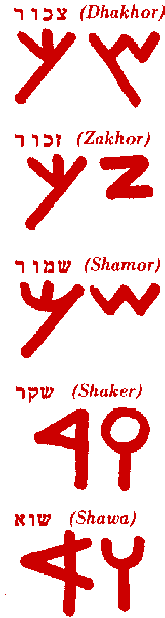
Why one
version has Zakhor
“remember” and the
other
Shamor “keep” is
explained by post-Mosaical
changes in Hebrew phonology and
palaeography.49)
The Mosaical
text must have had Dhakhor with
a voiced
interdental sibilant as in English
“the”
spelled Tzadi at the
beginning, which changed
its pronunciation to
Zayin.50) The original spelling
末末末末末末末
must have accumulated as
case-law over some 400 years
of
legal history during the ancient Republic of
Israel (Ibid. p.105).
The ownership of the
Ba‘al ha-Bayit or “master of
the house”
(Exodus 22, 7) is
comparable to the things and persons in
the
hand (manus) of the Roman
paterfamilias. A broad concept of
property
such as “any thing that is
thy neighbor’s” has to be
a rather
late generalization.
49) Three centuries after Moses a
sound change occurred
(Judges 12, 6), in
which Hebrew and Aramaic lost the “th”-sound,
so that
words like “the thing” would become
“ze sing or shing”
in Hebrew, and
“de ting” in Aramaic. A good example is
Zakhor,
for the Aramaic
Torin and Dikhrin (Ezra 7, 17)
correspond to
Hebrew Shewarim and
Zekharim. Hence the Mosaical
alphabet
had to have a
special letter for “th”, that I
spotted as Tzadi,
cf. TORAH OF THE
ALPHABET (N. 1) p.73.
50) The Exodus version of the Ten Commandments adjusted
to
the sound change with the new phonetic spelling
Zakhor, but
older or more conservative
manuscripts must have retained the
original
spelling Tzakhor with an
initial Tzadi in analogy to
the
inconsistent orthography of Tzahov “golden” and Zahav
“gold”
for archaic Dhahab.
[27]
of Tzadi and Kaf could later
be mistaken for
Shin and
Mem
yielding the word Shamor.51)
A similar divergence occurs in the
commandment
“Thou shalt not bear false
witness”, in which
the word “false” reads
Shaker in Exodus 20, 13
and Shawa in
Deuteronomy 5, 17. Here the
original
Kof and Resh of
Shaker were later
mistaken for Waw and Alef in
Shawa.52)
§
18. After having succeeded in fully
re-
constructing the original Tablets of
the Law,
hewn and written by
Moses 3427 years ago
in the Sinai,
it is safe to say that they were,
indeed,
the first document ever to be written
末末末末末末末
51) The Deuteronomy version of the Ten Commandments
is
based upon an old manuscript of the Torah of
Moses found
in 622 B. C. E. (2. Kings
22, 8). At this time Mem looked almost
like the original
Kaf, while Kaf was developping in the direction
of
its present shape. The difference of Shin and Tzadi was
only
a diacritical mark, so that
Tzakhor could easily be misread as
Shamor
(see below p.31).
52) The letter Kof
is in a very vulnerable
position
(cf. Note 26 supra), where the top of its circle may have
become
blurred, turning it into the letter
Waw. The first two letters of
Shamor are
in the same position on line 8 as the last two letters
of
Shaker on line 10, which suggests that they were
rendered
partially illegible by the same scratch. Since the number of letters
is
the same in both versions, their differences do not affect
the
reconstruction of the Tablets of the Law, and could be left
open.
[28]
in alphabetical script, which was conceived
by
the people of Israel.53) The reason for
placing
the letters Alef
and Bet at the top
of the
alphabetical order, and thus the
very name of
the alphabet results
from the Ten Command-
ments, for their
first line begins on face A of
the
first stone tablet with the letter Alef,
and
their second line on face B with the letter
Bet.
The Bible constitutes the
oldest collection of
alphabetical literature that
grew around the law
of the two
tablets of the Torah of
Moses,
and the alphabet
contains the key to
their
three-dimensional structure.54)
末末末末末末末
53) Not every phonetic script is an
alphabet in the strict
sense characterized by
its unique alphabetical order: Neither the
so-called
Egyptian “alphabet” of one-consonant hieroglyphs
nor
the so-called Ethiopian “alphabet”,
in spite of its Sinaitic origin,
are true
alphabets, because Alef and Bet were never placed at
the
top of their sequence of letters, and not sharing the Torah of
Moses
withIsrael, there was no reason
to do so.
54) See TORAH OF THE
ALPHABET (N. 1) p. 18. The
original
meaning of the Tablets of the Law has to be distinguished
from
their later interpretation (above Note
46). Such a double
interpretation (duplex
interpretatio) is also known in Roman Law,
where the Corpus Juris of
the Emperor Justinian may differ widely
from the classical
original, cf. Fritz Schulz (N. 20) p. 4. Similarly,
what
the Constitution of the United States of America means today
is not
always what the founding fathers meant.
[29]
APPENDIX
The 10 Lines
(Devarim)
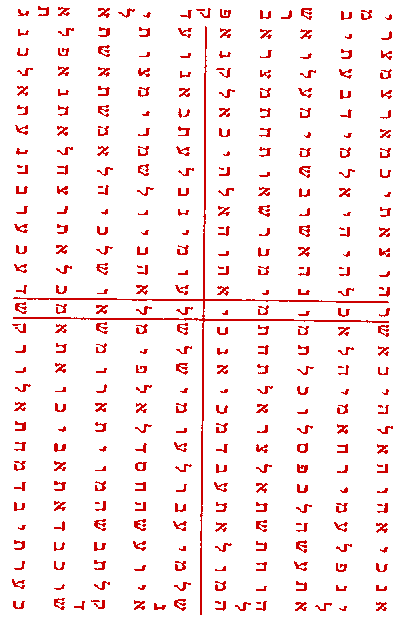
[30]
|
 Archives for Mosaical Metrology and Mosaistics, AMMM Vol. I, No.
2
Archives for Mosaical Metrology and Mosaistics, AMMM Vol. I, No.
2